Articles for Strategies for the Act Reading Test
How to Improve Your Deed Reading Score
If you've taken the ACT Reading section before and are planning to take information technology again, y'all're likely looking for Act Reading strategies that will show you how to meliorate your Deed Reading score. Y'all are also likely aware of but how catchy the ACT Reading section can be. Although the Act Reading section has fewer questions than the English and Math sections, it can withal feel overwhelming because of the extended prose passages yous have to read.
The Deed Reading tips and tricks in this commodity are designed to requite you the maximum strategic advantage as you take or retake this section of the ACT. Follow these ACT test strategies to make the Reading department feel more than manageable and straightforward.
Looking for more general Human activity study communication? Y'all might like our articles on How to Improve Your ACT Score and Deed Test Strategies. Need winning strategies for the other ACT sections? Check out all of the articles in our serial of ACT strategy guides:
- Human action English Strategies
- ACT Math Strategies
- ACT Reading Strategies (this article)
- ACT Science Strategies
- Act Writing Strategies
Deed Reading Exam Format
i. Learn What Content is Covered on the Act Reading Test
Have you e'er heard the saying "forewarned is forearmed"? Although it'southward kind of old-fashioned, it means that if you know what possible problems lie ahead, and then you can prepare to solve them. When it comes to ACT Reading strategies, existence forewarned is pretty good advice—so good, in fact, that information technology'due south our first Human action Reading strategy: learn what will be tested on the Reading section of the Human activity (being prepared besides reduces test anxiety).
The Human activity Reading examination is a 40-question, 35-minute test that consists of four sections, each of which includes 1 to two prose passages and is accompanied by ten multiple-choice questions. In that location are four types of passages on the Human action Reading Test, and they always announced in the aforementioned social club:
- Literary Narrative or Prose Fiction: this passage will consist of an extract from a novel, brusque story, personal essay, or memoir.
- Social Studies: this passage will hash out a topic related to the social sciences, such as history, anthropology, economic science, geography, politics, or sociology.
- Humanities: this passage will probable business organisation music, art, motion picture, or some other artistic field, and may be excerpted from a personal essay
- Natural Science: this passage will be about a scientific topic such as biology, geology, physics, or chemistry.
The test volition explicitly state the category at the beginning of each passage. The passages should all have the same difficulty level, only students will likely feel more comfortable with the passages that virtually closely chronicle to their ain interests.
Reading Test Breakdown
- Primal Ideas and Details (55-60%) – Students must identify central themes, selection out specific details, and draw conclusions about the nature of relationships between presented ideas.
- Craft and Structure (25-30%) – Students must determine the meaning of words and phrases and analyze the author'southward rhetorical and structural choices.
- Integration of Knowledge and Ideas (13-18%) – Students must evaluate the author's claim and, in some cases, observe connections between two different texts.
Reading Test Strategies
- Outset with your strengths
- Read the questions first
- Accept notes
If you're taking the ACT Reading section every bit part of the full ACT, you will encounter information technology third, afterwards the English and Mathematics sections. Y'all will get a brusk intermission between the Math and Reading sections—take advantage of that time to stretch, hydrate, use the restroom, and clear your head of numbers and formulas.
2. Familiarize Yourself with the 5 Question Types
Side by side on our list of how to improve your ACT Reading score is understanding the five question types you'll encounter during the exam. We've outlined these v types of questions below, listed in lodge of the average frequency (from loftier to low) in which they appear on ACT Reading tests.
We explain each blazon of question briefly for the sake of keeping this strategy review succinct. If you experience yous need more review of these Human action Reading strategies, Piqosity'due south seventy+ Deed content lessons include detailed information on how to master each blazon of ACT Reading question.
1. Specific Detail Questions
Specific Detail questions are typically the easiest kind of question to reply. On average, nearly half of all ACT Reading questions fall into this category. Every bit the proper noun implies, these questions ask you to pick specific details out of the text—no guesswork is involved. In fact, these questions will frequently reference a specific line or paragraph, telling you exactly where to await.
Ane note of caution, though: remember that the correct reply is unlikely to announced word-for-word in the passage. Instead, the correct answer will be paraphrased from the original. If you can notice a sentence in the passage that is synonymous with i of the respond choices, you can safely bet that it's the right one.
two. Structure and Function Questions
The second nearly common type of question on the ACT Reading section is Structure and Role Questions, which ask nigh how the passage is organized or how specific sentences or paragraphs function as function of the whole. These kinds of questions might, for case, ask why the author uses a certain instance or what kind of evidence would strengthen (or weaken) the writer'due south argument.
The answers to these kinds of questions will non be found direct in the passage, but you should still be able to answer them based on what you have read. Retrieve, you don't demand any prior knowledge about the subject thing covered in each passage to answer these kinds of questions.
Pro tip: Structure and Function questions seem to occur most often in Humanities passages.
3. Inference Questions
Inference Questions are similar to Structure and Function Questions in that the right answers are not directly stated in the passage but tin be deduced after careful reading. These kinds of questions are asking y'all to "read between the lines" or depict conclusions based on the testify provided in the passage.
If the question includes the phrases "We can infer…," "The passage suggests…," or something similar, y'all'll know it is an Inference Question. Even though you won't find the right answer paraphrased in the passage, you should nevertheless be able to point to specific textual bear witness that supports your answer. If you can't detect anything in the passage to support your choice, it's non the right answer.
4. Primary Idea Questions
Equally you might wait, Main Thought Questions ask you most the chief idea(s) of a passage; in this fashion, they are sort of like the contrary of Specific Particular Questions. The near important thing to remember is that the author of a passage volition reference the master idea in (nearly) every paragraph—if there'south a topic that recurs oftentimes, it'due south a good bet that information technology'southward the principal idea. Past the aforementioned token, be careful not to become tripped up by specific details masquerading as the right answer. If an reply references a item or thought that is referenced in only one judgement, information technology'south non the right answer—it's meant to play a trick on you!
Some other way to think about the Master Idea of whatsoever detail passage: if you lot had to summarize it in one sentence, what would you say? You probably would not include very many specifics and instead would give a broad outline. If one answer choice seems like a version of your own ane-sentence summary, information technology'south probably right.
5. Vocabulary in Context Questions
Although these questions are the least common on the Human action Reading department, there are however ordinarily a few of them on each test. They are very straightforward: yous will be asked to ascertain a discussion based on the fashion it is used in the passage.
Apparently, the best-case scenario is i in which you already know the meaning of the word. But if you lot don't recognize it, look at the sentence (the "in Context" part of "Vocabulary in Context") in which the word appears, and those around it, for clues every bit to its pregnant. If the word is used in contrast to another discussion, for instance, selection the respond which means the opposite of that other word.
Remember: sometimes, words have multiple meanings. If the vocabulary word in question is i of those words, one of the reply choices will often be the virtually usual definition, and it is commonly the wrong respond. Always make sure the definition you choose makes sense in context of the sentence.
Want to brush up on your vocabulary? Check out Piqosity'southward Vocabulary Exercise, with over two,750 words: Lower Level, Middle Level, and Upper Level.
3. Learn the Typical Tricks the ACT Uses to Trip Up Test Takers
In lodge to be a competitive test, the ACT purposefully tries to trick students with answers that might await right at showtime but are actually wrong. Learning these tricks is one of our favorite ACT reading strategies, as it can vastly improve your test-taking confidence and assist you lot avoid easy pitfalls.
Three common types of these "trick" answers are:
- Opposite Answers: Often, one of the choices will be the near-exact opposite of the correct answer. At offset glance, information technology might appear correct because information technology covers the same information equally the passage (and the correct answer), just it takes a contradictory position, so is incorrect.
- Distorted Answers: Another type of common fob answer is one that distorts information from the passage. Frequently, this involves taking something from the passage to an extreme; for example, if the passage states that something is sometimes true, the distorted (incorrect) reply might state that information technology is always true.
- Irrelevant Answers: A third mode the Act will try to trip you up is by including an answer which is true, only not relevant to the question. This might take the form of a detail that can be found in the passage but which does non answer the question, or an answer which includes true information that is not part of the passage and which, therefore, is likely irrelevant.
Fortunately, the Deed tends to deploy these same tricks again and once more, so once you're familiar with them, they're easier to spot. If you still experience confused by this and you lot're wondering how to meliorate your Human activity Reading score, the best manner to get comfortable with these kinds of questions and answers is to accept a do Act Reading section, like the ones institute on this gratuitous 2020 Act practice test.
four. Identify Your Specific ACT Reading Examination Weaknesses
Every student who takes the Act Reading test has their own set of test-taking strengths and weaknesses. Every bit we'll see momentarily in our department on strategic practice, in order to improve upon your particular weaknesses for the ACT Reading test, you'll demand to be able to place them first.
Common problems for students taking the Human activity Reading test include:
- Timing Problems: You scored very well on every question you answered, but didn't accept time to end, you'll know that what y'all need to work on most is increasing your exam-taking (or reading) speed.
- Close Reading Bug: Y'all are able to sympathize the full general ideas put forward in passages, but tend to miss questions that pertain to specific details (such as the aptly named Specific Details questions).
- General Comprehension Problems: Yous are able to detect evidence- and detail-based answers but tend to miss questions that pertain to overarching concepts in a passage (such as Main Idea Questions).
- Vocabulary Problems: You lot are able to respond both questions pertaining to details and concepts, but Vocabulary in Context questions tend to trip you upward.
5. Brush Upwardly on Specific ACT Reading Exam Strategies
In one case you've got a good grasp of the question types, it's time to focus on a handful of Deed Reading strategies designed to aid you with the bodily process of taking the Human action Reading examination. Remember, taking a standardized test similar the ACT is a skill, and as with all skills, practice makes perfect. These ACT Reading tips and tricks volition assistance maximize your chances of success.
Start with Your Strengths
Always begin with the ACT reading passage which relates most closely to your personal interests. If your favorite subject in school is science, for instance, start with the Natural Science option; if y'all love reading novels in your spare time, start with Prose Fiction.
Read the Questions Get-go
How do yous approach reading on the Human action? Before you starting time any of the Human action Reading passages, skim the questions that follow it—they will requite yous a good idea of what's most of import to pay attention to when reading. (Frequently, the questions will directly reference specific lines in the text—brand sure to mark those lines in the passage!)
Later you accept finished reading, endeavor to respond the questions without looking at the reply choices; if your instinctive respond matches one of the choices, yous can be confident it's the right reply. This strategy helps to ensure that you are not overly influenced past the respond choices, 3 of which are always wrong.
Have Notes
Sometimes our brains go on autopilot and we read over an entire passage without actually comprehending information technology. Another crucial key to how to improve your Human action reading score is to practice agile reading by taking notes every bit yous read. For example, y'all can underline the key ideas in each paragraph or make brief summaries in the margins.
Taking notes helps you focus, ensures your understanding of a passage, and creates a roadmap back to important information in the text. This roadmap oftentimes proves helpful when you're answering questions that have answers that can be institute directly in the text, such as Specific Detail or Vocabulary in Context questions.
In addition to taking notes, you may observe it useful to check in with yourself every paragraph or even every few sentences. Would you be able to draw what yous only read to someone else? If you're having trouble summarizing, it's a skillful sign y'all need to re-read that paragraph. Being able to summarize concepts volition aid you answer Main Idea and Inference questions.
An Case of How to Apply These ACT Reading Strategies:
Permit's examine at a practise Human action Reading passage (taken from the free official 2020 Practice ACT) and use our strategies to answer a couple of practice questions.
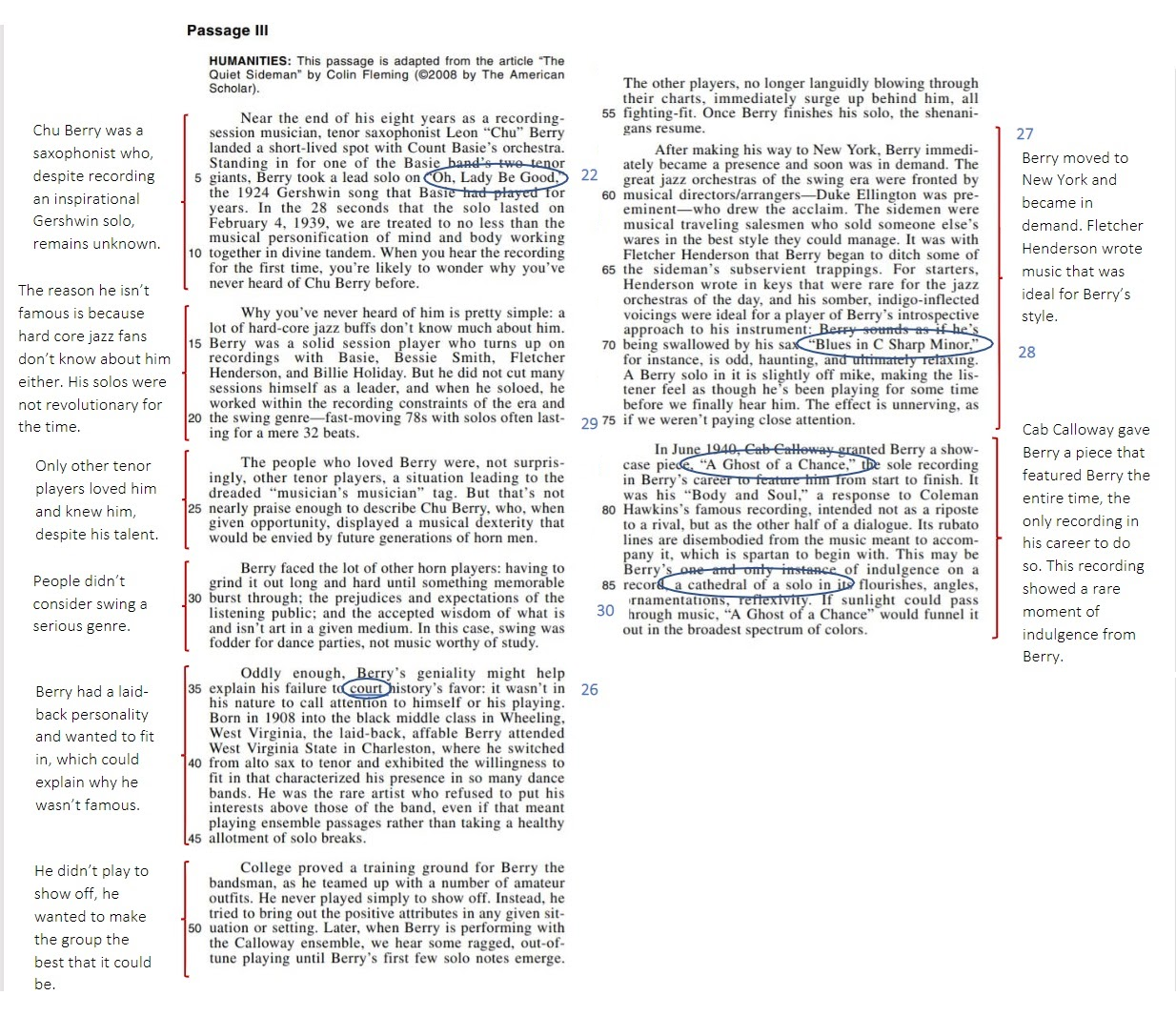
In the example passage above, we have circled key words that appear in specific questions and written their respective question numbers next to them. In the margin, nosotros have briefly summarized each paragraph as an example of how the reader should bank check in with themselves to ensure that they understand what they simply read.
Now, let's await at an example question:
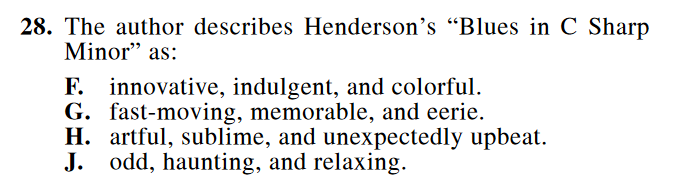
Before looking at the respond choices, let'south go to the passage and encounter if we can come up with our own answer. At the cease of paragraph 7, the author describes the "Blues in C# Minor" (which we circled!) equally "odd, haunting, and ultimately relaxing." Looking at the answer choices, we tin come across that the data nosotros found in the passage best matches answer choice D.
One more than question:
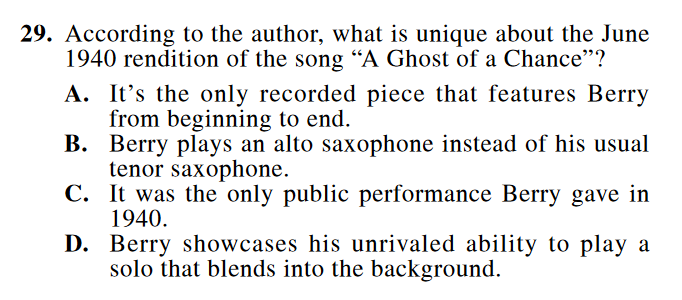
We circled the key phrase "A Ghost of a Chance" at the beginning of the concluding paragraph. The writer states that it is the sole recording in Berry's career that featured him from start to finish. Now let's look at the respond choices. Based on the information provided by the author, we know the answer is A.
half dozen. Practice Strategically
If yous apply only one of our tips for how to improve your ACT reading score, this is the one you want to use. We truly can't emphasize the importance of regular ACT practice enough. The more you exercise, the more than familiar you will be with the test, and the more likely y'all will go an outstanding score.
Nosotros recommend the post-obit 4-footstep plan to proceeds the maximum strategic advantage.
1. Take a total do ACT Reading test
After you've spent some significant time going over the different types of questions and studying Deed Reading strategies, take a practice ACT Reading section, like 1 of the two below:
- 2019-2021 Free Deed Do Test (Form 1874FPRE)
- 2015-2018 Costless Human activity Exercise Test (Course 1572CPRE)
We recommend trying to imitate real-life testing weather. Clear your workspace of everything except your testing materials. Gear up a timer for 35 minutes, and piece of work through as much of the exam equally you can; stop when the time's upwards, fifty-fifty if you're non done. Every bit you lot're taking the test, put a star side by side to whatsoever questions you estimate on. When the timer goes off, stop and circumvolve every question yous didn't have time to answer.
2. Grade your practice test and read the answer explanations
Mark each question "right" or "incorrect." For each question (even the ones you got right), read over the answer explanations. Go over each possible answer choice and larn why it is right or wrong. You volition, of course, want to pay special attention to the questions yous missed to meliorate empathize how you went wrong. Utilize the links below to access the answer explanations to previously published practice ACT Reading tests:
- Reading Answer Explanations from 2019-2021 Human activity Do Test
- Reading Respond Explanations from 2015-2018 ACT Practice Examination
3. Keep analyzing the data, finding your weak spots, and identifying solutions
Equally we covered higher up, recognizing your noesis gaps and test taking weaknesses is a crucial part of figuring out how to meliorate your Act reading score. Equally you continue to practice, you lot volition desire to continually assess whether your weaknesses are improving and whether you've identified new problem areas. Use your grading notes to depict conclusions virtually what yous need to piece of work on.
If your examination taking weaknesses center effectually particular kinds of questions (equally opposed to timing), Piqosity tin can help. Our Deed Answer Explanations categorize every question based on its type, helping yous to go consistent and thorough practice. If your weakness is related to timing, our platform allows you to simulate a testing environs so that y'all can improve your performance in this area also.
4. Target your weaknesses with practise
Now that you know your weak spots, you'll want to spend the majority of your study time focusing on those areas. This is where Piqosity'south lxx+ content lessons and personalized do options really come in handy—you can create exercise tests which specifically target the areas where you most need improvement.
Of course, you want to make sure not to lose ground in your strongest subject areas. 1 helpful strategy is to dissever your fourth dimension more equally the closer y'all get to the test day. If, for instance, y'all had a month of prep time, yous might spend the first week working exclusively on practice questions targeting your weakest content areas. In the 2d week you lot would continue working mostly in those areas, merely by the finish of the calendar month y'all would spend equal fourth dimension preparing for all of the content areas. (You might even take another total practice ACT Reading test.)
Curious near the effectiveness of Deed prep? Read Piqosity'southward deep-dive commodity: Does ACT Prep Work?
7. If Applicative, Brush up on Act Reading Strategies for Ho-hum Readers
Everyone reads at a different speed, and if you're not a fast reader, the Act Reading passages tin seem intimidating. Slower readers may exist especially worried near running out of fourth dimension reading the passages. Depending on how much time y'all accept to set for the ACT Reading department, there are a couple of Act Reading tips for ho-hum readers that tin can assist.
If you are a slower reader: when you're faced with an ACT Reading passage, try to skim it for the essentials instead of getting bogged down in a fourth dimension-consuming shut reading. While it is important to understand the passage in its entirety, it is not essential to think every item upon first reading. It is much more than important to have a general agreement of the passage. Similarly, if yous see a word with which you are not familiar, don't waste matter time agonizing over its meaning; instead, try to empathize the main idea of the sentence from context clues.
Of course, the best fashion to increase your reading speed is merely to read more—of anything! Reading increases your vocabulary and familiarity with different sentence structures and writing styles. When faced with a new passage to read, you volition feel more comfortable if yous have a broader range of past reading with which to compare it.
Examination Practice with Piqosity: The Ultimate in ACT Reading Strategies
Now that yous know how to ameliorate your Human activity Reading score, information technology'due south time to become studying! Whether you're a student who wants to improve their ACT test taking skills, a teacher with multiple students wishing to give their scores a boost, or a tutoring visitor in demand of a exam prep LMS that really works, Piqosity has y'all covered with quality, affordable test prep materials.
Piqosity provides personalized practise test questions that help you address and meliorate upon your weaker examination subject areas. Our software is engineered to help students study smarter, not harder. We offering a broad range of ACT prep materials, perfect for both tutored and self-guided Human activity practice:
- 10 full-length ACT Practice tests
- Over 70 concept lessons, including tutorial videos
- Real-time Score prediction (both Composite and for each Subject)
- Interactive interface assuasive teachers, tutors, or parents to assign and track student work
- …and much more!
The best part? Piqosity for the Human activity is entirely free during the pandemic and is as well typically available to try for free with our 7-mean solar day trial. Sign upwardly today!
More than Educational Resources past Piqosity:
- The Difference Betwixt the ACT & the Sabbatum
- Act Writing Examination Scoring, Tips, and Strategies
- Answer Explanations to the Official Human action Practice Tests
- How to Amend your Human action Score
- How to Manage Testing Anxiety
Share This Story, Choose Your Platform!


thompsonconcestly.blogspot.com
Source: https://www.piqosity.com/how-to-improve-act-reading-score/
0 Response to "Articles for Strategies for the Act Reading Test"
Post a Comment