Book Review for Syncretism the Religious Context of Christian Beginnings in Korea
Religion in Taiwan (2005 demography)[one] [ needs update? ]
Non Religious (18.7%)
Other or undeclared (1%)


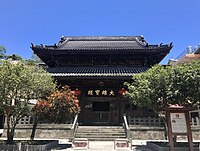
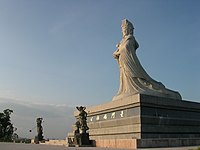
Religion in Taiwan is characterised by a multifariousness of religious behavior and practices, predominantly those pertaining to the continued preservation of the ancient Chinese civilization and religion. Freedom of faith is inscribed in the constitution of the Republic of China (Taiwan), and ranks loftier at nine.2 on the Liberty Scale in 2018 according to the Globe Bank.[2]
The majority of Taiwanese people practice a combination of Buddhism and Taoism often with a Confucian worldview, which is collectively termed equally Chinese folk religion.
Many statistical analyses endeavour to distinguish between Buddhism and Taoism in Taiwan, which, along with Confucianism, are rather aspects within broader "ancient Chinese religion". Information technology is hard to make such distinction considering various Taoist deities are worshipped aslope deities which originated in Buddhism, for instance Guanyin, in many temples across the land.
Equally of 2019[update], there were xv,175 religious buildings in Taiwan, approximately ane place of worship per 1,572 residents. 12,279 temples were dedicated to Taoism and Buddhism. There were nine,684 Taoist Temples and ii,317 Buddhist Temples.[iii] In Taiwan's 36,000 square kilometers of country, in that location are more than 33,000 places for religious (believers) to worship and gather. On boilerplate, there is one temple or church (church) or religious building for every foursquare kilometer. The high density of place of worship is rare in the earth, and it is the area with the highest density of religious buildings in the Chinese-speaking world. Taiwan is considered to be the near religious region in the Chinese-speaking world. Even for Christianity, there are ii,845 Churches.[3]
History [edit]
Prior to the 17th century the isle of Taiwan was inhabited past the Taiwanese aborigines of Austronesian stock, and there were small settlements of Chinese and Japanese maritime traders and pirates.[four] Taiwanese aborigines traditionally practised an animistic ethnic faith. When the island fell under Dutch rule in 1624, Protestantism was spread to the Taiwanese aborigines. 2 years later, with the transition to Castilian rule, the Catholic Church was introduced into the isle.
When the Han Chinese began to settle the island and form the Taiwanese Chinese ethnic group, exchanges between the indigenous religion of the Austronesian aborigines and the Chinese folk religion occurred.[5] For instance, Ali-zu, the Siraya god of fertility, has been incorporated into the Han pantheon in some places of Taiwan.[six]
17th and 18th centuries [edit]
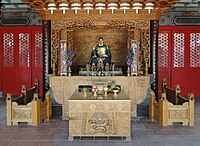
Main altar of the Shrine of Koxinga in Tainan.
A large influx of Han Chinese began in the 1660s with the transition of imperial power from the Ming dynasty to the Manchurian Qing dynasty.[7] Many Ming loyalists fled to the south, including Zheng Chenggong alias Koxinga, a military warlord who fought against the Manchu dynasty.[7] He sailed to Taiwan in 1661 with thousands of troops, and in a war with the Dutch, he defeated and collection out the Dutch military forces and established the Kingdom of Tungning, the first Chinese state on the island.[vii] Chinese settlers, generally from Fujian and Guangdong, began to migrate to the island.[7] The policy of migration to Taiwan was restrictive until 1788, even after the island came under the political control of the Qing in 1683.[vii]
Chinese migrants brought with them the Chinese traditional religions from their hometown, which served to integrate communities effectually the worship of Chinese Deities.[7] Equally the settlers were mostly males, came from dissimilar areas, and at outset not many people shared the same surnames and belonged to the same kins, ancestral shrines of kinship gods did non develop until the 1790s, when sufficient generations of families had established on the isle.[8]
The kickoff settlers in Koxinga and Qing periods brought with them images or incense ashes from mainland temples, installed them in homes or temporary thatched huts, and afterwards in proper temples, as economic circumstances permitted to build them.[9] Prominent temples became the foci of religious, political and social life, often eclipsing Qing officials and state-sponsored temples in their influence.[nine]
There is little prove that the doctrinal and initiatory religions of Buddhism and Taoism were active during this menstruation.[ix] Taiwan, as a frontier country, was not attractive for Buddhist and Taoist religious leaders.[ix]
19th century [edit]
During the mid-Qing dynasty, sects of popular Buddhism which the Japanese authorities would have afterwards lumped together with the religions of fasting (zhāijiāo) because of their vegetarian precepts, began to send missionaries from the mainland to Taiwan.[ten] They were more successful in attracting converts than either pure Buddhism or Taoism.[10] Japanese researches of the early colonial menses identified zhaijiao sects as a line of the Linji school of Chan Buddhism, although contemporary scholars know that they were centered on a female creator deity, Wusheng Laomu, and identify them as branches of Luoism disguising as a form of Buddhism complimentary of ordained clergy.[10] Zhaijiao sects identify the sangha as the community of believers, non as a separate clergy.[11]
Autonomously from zhaijiao Buddhist sects, other folk religious sects, that were mistakenly classified as Buddhist by the Japanese government, were active in Taiwan.[12] The nearly prominent were the three religions of fasting: the Jinchuang, the Longhua, and Xiantiandao traditions (the latter was introduced to Taiwan in the mid-19th century).[12]
20th century—Japanese dominion [edit]
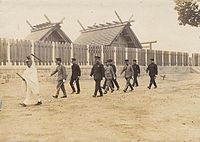
In 1895, the Manchu government ceded Taiwan to Japan every bit part of the terms of surrender following the Start Sino-Japanese War.[12] During the fifty-i years of Japanese dominion, governors enacted regulations to control the activities of "native religions".[13] During a commencement period from 1895 to 1915, the Japanese adopted a laissez-faire policy towards native religions.[thirteen] During a 2nd phase from 1915 to 1937, the regime tried to vigorously regulate local religions.[thirteen] A third catamenia, coinciding with the outbreak of hostilities between Nippon and prc, saw the Japanese government showtime a "Japanisation move" (Japanese: 皇民化運動, Hepburn: kōminka undō ) that included a "temple-restructuring movement" ( 寺廟整理運動 , jibyō seiri undō ).[xiii]
During the Japanese period many indigenous groups were forcibly converted to Shintoism, only a few (such as the Saisiyat people) were able to resist and maintain their traditions. Oft this was done by disarming Japanese anthropologists to come to Taiwan and document religious traditions as legitimate cultural heritage even so even the ethnic people immune to proceed some traditional ceremonies were still forced to pray at Shinto temples.[14]
Buddhism, as a shared heritage of China and Japan, received amend treatment than Chinese folk religion and Taoism.[xv] Some Taiwanese Buddhist groups cooperated with the Japanese government, and Japanese Buddhist sects sent missionaries to Taiwan and even worked with zhaijiao Buddhist groups.[sixteen] The full number of Japanese Buddhist groups that were introduced to Taiwan could be categorized into 14 sects under 8 schools. However, given the profound differences between Chinese and Japanese Buddhist traditions (among others, Japanese priests marry, swallow meat and potable wine, all of which Chinese monks abjure from), the "Japanisation" of Chinese Buddhism was resisted by Taiwanese Buddhist communities.[17]
In 1915, Japanese religious policies in Taiwan changed afterwards the "Xilai Hermitage incident".[17] The hermitage was a zhaijiao Buddhist hall where the follower Yu Qingfang (余清芳) started an anti-Japanese uprising, in which many other folk religious and Taoist sects took role.[17] The Japanese regime discovered the plot and Yu Qingfang was executed in a speedy trial together with 90-four other followers.[17]
After the incident, the Japanese government became suspicious of what it chosen Taiwan'due south "old religious customs" ( kyūkan shūkyō ).[17] The government began to investigate, register and regulate local temples, and it created islandwide Buddhist religious associations—into which fifty-fifty zhaijiao Buddhist groups were enrolled—whose charters recommended loyalty to the government.[18]
In 1937, after the Marco Polo Bridge Incident and the outset of the Second Sino-Japanese War, Tokyo ordered the rapid acculturation of the peoples of Japan's colonies.[nineteen] This included an try to disaccustom people from Chinese traditional religions and catechumen them into the nexus of State Shinto.[19] Many Shinto shrines were established in Taiwan. Chinese family altars were replaced with kamidana and butsudan, and a Japanese calendar of religious festivals was introduced.[19]
The subsequent "temples' restructuration movement" caused much consternation among the Chinese population and had far-reaching effects.[20] Its inception tin can be traced back to the "Conference for Improving Popular Community" held in 1936, that far from promoting a razing of temples discussed measures for a reform and standardisation of Taoist and folk temple practices.[19]
The outbreak of open state of war betwixt Red china and Nippon in 1937 led to a proscription of practices and even stronger measures, equally Japanese officials saw the religious culture centered effectually folk temples as the major obstacle to Japanisation.[20] Consequently, some local officials began to close and to annihilate temples, called-for their images, confiscating their cash and real estates, a measure that they chosen "sending the gods to Heaven".[20] In 1940, when a new governor-general took office, the "temples' restructuration movement" was halted.[21]
The Japanese persecution of Chinese folk faith led to an increase in skepticism and loss of faith among the Chinese.[22] As a consequence of this loss of faith in gods, Japanese law reported a full general reject in public morals.[22] The policies besides resulted in the disappearance of the small Muslim community, until Islam was reintroduced by the Kuomintang with their retreat from mainland China to Taiwan afterward the terminate of Chinese Civil War in 1949.[23]
Another effect of the Japanese colonisation on religious life in Taiwan was due to the modernisation of infrastructures.[24] Earlier the 20th century the travel infrastructure of Taiwan was non very adult, and it was difficult for people to motion from a part of the island to another.[24] The Japanese quickly constructed a network of railroads connecting all regions of the island.[24] In the field of organized religion, this promoted the rise in importance of some Buddhist, Taoist or folk temples equally isle-wide pilgrimage sites.[24] During this time, some gods lost their local and sub-indigenous nature and became "pan-Taiwanese".[25]
1945 onwards—Republic of Red china rule [edit]
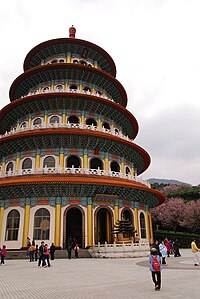
Tianyuanggong, a temple of Yiguandao in Tamsui, New Taipei.
In 1945, afterward the Second Globe War, the assistants of Taiwan was handed over to the Democracy of Mainland china through General Order No. 1. The People's Republic of China was established four years later in mainland Cathay under the Communist Party of Cathay.
In 1949, the 63th Celestial Master of Taoism Zhang Enpu 張恩溥 escaped from mainland China to Taiwan when the Regime of the Republic of Red china retreated to Taiwan later on losing the Chinese Civil War, bringing the religious leadership and orthodoxy of Zhengyi Dao to Taiwan. The lineage for the Angelic Master had since passed on to the 65th Angelic Master Zhang Yijiang 張意將.
The rapid economical growth of Taiwan since the 1970s and 1980s ("Taiwan Phenomenon") accompanied by a quick renewal of Chinese folk religion, challenging Max Weber'due south theories on secularisation and disenchantment, has led many scholars to investigate how folk religious culture, with its emphasis on values like loyalty, its social network of temples and gods' societies, may have contributed to the island's economic evolution.[26] During the same period, folk religions developed ties with ecology causes.[27] Chinese salvationist religions (such as before Xiantiandao) become increasingly popular in Taiwan after 1945, although some of them were illegal until the 1980s.[28]
After the 1950s, and especially since the 1970s, at that place was a significant growth of Buddhism.[29] Chinese Buddhism adult into distinctively new forms with the foundation of organizations like the Tzu Chi, the Fo Guang Shan and the Dharma Drum Mountain, which follow the Humanistic Buddhism move that was founded in mainland China during the early 20th century.[30] Many highly realized Buddhist masters such equally Chief Hsing Yun, Master Sheng-yen , Master Yin Shun escaped from mainland Communist china to Taiwan when the Regime of the Republic of Mainland china retreated to Taiwan later losing the Chinese Ceremonious War. They promoted Humanistic Buddhism reformist movement in Taiwan, which was pioneered by Master Taixu in mainland Cathay.Tibetan Buddhism also had spread into the island.[thirty] Since the 2000s there was an increasing cooperation between religious groups in Taiwan and mainland China which decreased tensions between them. Despite this, in that location are yet tensions from past events including Taiwan existence removed from the UN because of Cathay.[31] [32]
Religions [edit]
Principal religions [edit]
Chinese folk religion [edit]
Chinese traditional, popular or folk religion, or simply Chinese religion, also called Shenism, defines the collection of grassroots ethnic religious and spiritual experiences, disciplines, beliefs and practices of the Han Chinese. Another name of this circuitous of religions is Chinese Universism, coined by Jan Jakob Maria de Groot, and referring to Chinese religion's intrinsic metaphysical perspective.[33] [34]
It consists in the worship of the shen (神 "gods", "spirits", "awarenesses", "consciousnesses", "archetypes"; literally "expressions", the energies that generate things and make them thrive) which tin can be nature deities, city deities or tutelary deities of other human agglomerations, national deities, cultural heroes and demigods, ancestors and progenitors, deities of the kinship. Holy narratives regarding some of these gods are part of Chinese mythology.
Chinese folk religion in Taiwan is framed by the ritual ministry building exerted by the Zhengyi Taoist clergy (sanju daoshi), independent orders of fashi (not-Taoist ritual masters), and tongji media. The Chinese folk religion of Taiwan has characteristic features, such as Wang Ye worship.[35] Even though Falun Gong is banned in China, people in Taiwan are free to practise it.[36]
-

Folk Taoists officiating a ceremony in Taichung.
-
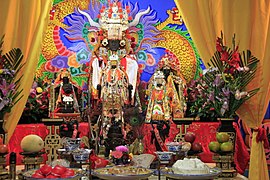
An chantry dedicated to diverse gods at a temple in Tainan.
-

Temple of Fude in Wujie, Yilan.
-
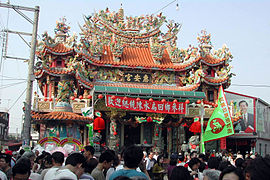
Hui'an Temple in Kuantien, Tainan. The festival welcomed politico Chen Shui-bian home after his 2004 re-ballot.
-
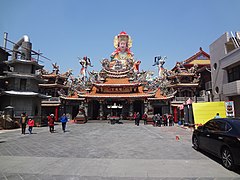
Hotsu Longfong Temple defended to Mazu in Miaoli.
Chinese salvationism [edit]
As of 2005, more than ten% of the population of Taiwan adhered to a multifariousness of folk religious organisations of conservancy. The largest of them is Yiguandao (with three.5% of the population), followed by Tiandiism (whose two churches, the Holy Church of the Heavenly Virtue and the Lord of Universe Church building, counted together constitute 2.ii% of the isle'due south population), Miledadao (an offshoot of Yiguandao accounting for i.1%), Zailiism (0.8%) and Xuanyuanism (0.7%), and other small movements including Precosmic Salvationism and Daiyiism.[1] The three largest ones—Yiguandao, Tiandiism and Miledadao—and some others derive from the Xiantiandao tradition, making this the religious tradition of more than vii% of Taiwan'due south population. Other salvationisms with an of import presence in Taiwan, though not documented in the 2005 official statistics, are Confucian Shenism (also chosen Luanism) and the recent Weixinism.
-

A Yiguandao-organised Confucian ceremony for the worship of gods and Sky in March 2017. Yiguandao elders are those clad in grayness robes.
-

The Luanist Rebirth Church (重生堂 Chóngshēngtáng) in Taichung.
Taoism and Confucianism [edit]
Taoism in Taiwan is about entirely entwined with folk organized religion,[37] equally it is mostly of the Zhengyi school in which priests function every bit ritual ministers of local communities' cults.[37] Taiwanese Taoism lacks a contemplative, austere and monastic tradition such as northern People's republic of china'south Quanzhen Taoism. The Celestial Masters, leaders of the Zhengyi schoolhouse, accept their seat on the island. Nowadays the part is carve up into at least three lines competing to head the Taoist community.[37]
Politicians of all parties appear at Taoist temples during campaigns, using them for political gatherings.[37] Despite this and the contention among sects for leadership, there is no unitary structure of authority overseeing all Taoists in Taiwan.[37] According to the 2005 demography, at that place were vii.vi million Taoists in Taiwan (33% of the population) in that year.[1] As of 2015, there were 9,485 registered Taoist temples in Taiwan, constituting 78% of all registered temples.[38]
Confucianism is present in Taiwan in the grade of many associations and temples and shrines for the worship of Confucius and sages.[39] In 2005, 0.7% of the population of Taiwan adhered to Xuanyuanism, which is a Confucian-based organized religion worshipping Huangdi as the symbol of God.[xl]
-

Temple of the Great Peace in Caotun, Nantou.
-

Sanye Temple in Bao-an, Tainan.
-

Ceremony at a Temple of Confucius in Chiayi.
Buddhism [edit]
Buddhism was introduced into Taiwan in the mid-Qing dynasty (18th century) through the zhaijiao popular sects.[x] Several forms of Buddhism thrived in Taiwan ever since. During the Japanese occupation, Japanese schools of Buddhism (such as Shingon Buddhism, Jōdo Shinshū, Nichiren Shū) gained influence over many Taiwanese Buddhist temples as part of the Japanese policy of cultural assimilation.[sixteen]
Although many Buddhist communities affiliated themselves with Japanese sects for protection, they largely retained Chinese Buddhist practices. For instance the Japanisation of Chinese Buddhism, the introduction of clerical marriage and the do of eating meat and drinking vino, was not every bit successful as in the Buddhist tradition of Japanese-occupied Korea.[16]
Following the end of Earth War Two and the establishment of the Republic of China on the island, many monks from mainland China moved to Taiwan, including Yin Shun (印順) who is generally considered to be the key figure who brought Humanistic Buddhism to Taiwan. They gave significant contribution to the development of Chinese Buddhism on the isle.
The Buddhist Association of the Republic of China remained the dominant Buddhist system until the stop of restrictions of religious activities in the 1980s. Today at that place are several large Humanistic Buddhist and Buddhist modernist organisations in Taiwan, including the Dharma Drum Mountain (Făgŭshān 法鼓山 ) founded by Sheng Yen ( 聖嚴 ), Buddha's Light International (Fógŭangshān 佛光山 ) founded by Hsing Yun ( 星雲 ), and the Tzu Chi Foundation (Cíjì jījīnhùi 慈濟基金會 ) founded by Cheng Yen ( 證嚴法師 ).
The zhaijiao Buddhist groups maintain an influence in society. In recent decades, also non-Chinese forms of Buddhism, such as Tibetan Buddhism and Soka Gakkai Nichiren Buddhism, accept expanded in Taiwan.[30] Adherence to Buddhism has grown significantly in Taiwan since the 1980s.[29] From 800.000 in 1983 (4% of the population), the number of Buddhists expanded to 4.9 million in 1995 and later on to eight meg (35% of the population) in 2005.[41]
-

Shuang Ho Jing Temple of the Tzu Chi, in Zhonghe, New Taipei.
-

-

Temple of the Great Buddha in Changhua.
-

-

Karma Kagyu Temple, a temple of Tibetan Buddhism in Tainan.
Minor religions [edit]
Baháʼí Faith [edit]
The history of the Baháʼí Faith (Chinese: 巴哈伊教; pinyin: Bāhāyījiào ) in Taiwan began later on the faith entered areas of China[42] and nearby Nippon.[43] The starting time Baháʼís arrived in Taiwan in 1949[44] and the first of these to have get a Baháʼí was Jerome Chu (Chu Yao-lung) in 1945 while visiting the United States. By May 1955 there were eighteen Baháʼís in six localities across Taiwan. The first Local Spiritual Associates in Taiwan was established in Tainan in 1956. With a growing number of Local Spiritual Assemblies (Taipei, Tainan, Hualien and Pingtung), the Taiwanese National Spiritual Associates was established in 1967. In the 2005 official statistics on organized religion issued by the Section of Civil Affairs, the Baháʼís had xvi,000 members and 13 Local Spiritual Assemblies.[1]
Christianity [edit]
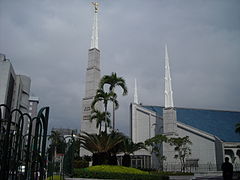
Christianity in Taiwan constituted 3.9% of the population co-ordinate to the census of 2005.[one] Christians on the island included approximately 600,000 Protestants, 300,000 Catholics and a small number of Members from The Church of Jesus Christ of Latter-24-hour interval Saints.[1]
Despite its minority condition, many of the early Kuomintang political leaders of the Republic of China were Christians. Several Republic of Cathay presidents have been Christians, including Sun Yat-sen who was a Congregationalist, Chiang Kai-shek and Chiang Ching-kuo who were Methodists, Lee Teng-hui is a fellow member of the Presbyterian Church. The Presbyterian Church has strong ties with the Democratic Progressive Political party since the 1980s.
Christianity in Taiwan has been on the refuse since the 1970s, later on a potent growth from 1950 to the 1960s.[45]
-

Sacred Eye of Jesus Catholic Church building in Shulin, New Taipei.
-

-
Islam [edit]
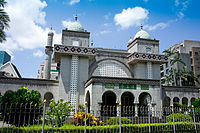
Though Islam originated in the Arabian Peninsula, it had spread eastward to China as early equally the 7th century CE. Muslim merchants married local Chinese women, creating a new Chinese indigenous group chosen the Hui people. Islam first reached Taiwan in the 17th century when Muslim families from the southern China's coastal province of Fujian accompanied Koxinga on his invasion to oust the Dutch from Taiwan. Islam did not spread and their descendants became assimilated into the local Taiwanese guild adopting the local customs and religions.
During the Chinese Civil War, some twenty,000 Muslims, generally soldiers and civil servants, fled mainland China with the Kuomintang to Taiwan. Since the 1980s, thousands of Muslims from Myanmar and Thailand, who are descendants of nationalist soldiers who fled Yunnan as a issue of the communist takeover, have migrated to Taiwan in search of a better life. In more than recent years, there has been a rise in Indonesian workers to Taiwan. According to the census of 2005, there were 58,000 Muslims in Taiwan in that year.[one]
In 2021 there were 280,000 Muslims living in Taiwan with most being foreign nationals. Taiwan is highly ranked as a Muslim friendly tourism destination.[46]
Judaism [edit]
There has been a Jewish community in Taiwan since the 1950s.[47] Since 2011, there has been a Chabad in Taipei.[48]
Shinto [edit]
Gaoshi Shrine was the starting time Shinto shrine rebuilt after Earth War Ii.

Census statistics [edit]
The tabular array shows official statistics on religion issued by the Section of Civil Affairs, Ministry of the Interior ("MOI"), in 2005. The Taiwanese authorities recognises 26 religions in Taiwan.[1] The statistics are reported by the various religious organisations to the MOI:[1] [49]
| Religion | Members | % of total population | Temples & churches |
|---|---|---|---|
| Buddhism ( 佛教 ) (including Tantric Buddhism) | 8,086,000 | 35.one% | four,006 |
| Taoism, Chinese Buddhism and folk faith ( 道教 ) | seven,600,000 | 33.0% | 18,274 |
| Yiguandao ( 一貫道 ) | 810,000 | 3.5% | three,260 |
| Protestantism ( 基督新教 ) | 605,000 | two.6% | 3,609 |
| Roman Cosmic Church ( 羅馬天主教 ) | 298,000 | 1.iii% | ane,151 |
| Lord of Universe Church—Tiandiism ( 天帝教 ) | 298,000 | 1.3% | 50 |
| Miledadao ( 彌勒大道 ) | 250,000 | 1.ane% | ii,200 |
| Holy Church of the Heavenly Virtue—Tiandiism ( 天德教 ) | 200,000 | 0.9% | fourteen |
| Zailiism/Liism ( 理教 ) | 186,000 | 0.8% | 138 |
| Xuanyuanism ( 軒轅教 ) | 152,700 | 0.7% | 22 |
| Islam ( 伊斯蘭教 ) | 58,000 | 0.three% | vii |
| Mormonism ( 耶穌基督後期聖徒教會 ) | 51,090 | 0.2% | 54 |
| Tenriism ( 天理教 ) | 35,000 | 0.2% | 153 |
| Church of Maitreya the King of the Universe ( 宇宙彌勒皇教 ) | 35,000 | 0.ii% | 12 |
| Haizidao ( 亥子道 ) | 30,000 | 0.1% | 55 |
| Church of Scientology ( 山達基教會 ) | 20,000 | < 0.1% | 7 |
| Baháʼí Faith ( 巴哈伊教 ) | 16,000 | < 0.1% | 13 |
| Jehovah'south Witnesses ( 耶和華見證人 ) | ix,256 | < 0.1% | 85 |
| True School of the Mysterious Gate ( 玄門真宗 ) | 5,000 | < 0.1% | v |
| Holy Church building of the Center Flower ( 中華聖教 ) | 3,200 | < 0.1% | 7 |
| Mahikari ( 真光教團 ) | 1,000 | < 0.1% | ix |
| Precosmic Salvationism ( 先天救教 ) | 1,000 | < 0.i% | 6 |
| Yellow Middle ( 黃中 ) | 1,000 | < 0.one% | 1 |
| Dayiism ( 大易教 ) | 1,000 | < 0.1% | 1 |
| Total religious population | 18,724,823 | 81.3% | 33,223 |
| Total population | 23,036,087 | 100% | - |
The figures for The Church building of Jesus Christ of Latter-day Saints were not from the MOI, rather they were based on self-reported data from LDS Newsroom.[50] The figures for Jehovah'southward Witnesses were not from the MOI and they were based on the Witnesses own 2007 Service Year Report. In the original report both of them were counted as part of Protestantism.[one]
See also [edit]
- Chinese folk religion
- Chinese bequeathed worship & Ancestral temples
- Baishatun Mazu Pilgrimage
- Qing Shan Male monarch Sacrificial Anniversary
- Wang Ye worship
- Four Smashing Mountains (Taiwan)
- Temples of Taichung
- Listing of Shinto shrines in Taiwan
- Organized religion in Communist china
- Religion in Hong Kong
- Organized religion in Macau
- List of temples in Taiwan
References [edit]
Citations [edit]
- ^ a b c d e f g h i j "Taiwan Yearbook 2006". Taiwan Government Information Office, Department of Civil Affairs, Ministry of the Interior. 2006. Archived from the original on 8 July 2007.
- ^ "Freedom of religion, Calibration". Globe Bank. 2018. Retrieved 2 June 2021.
- ^ a b "表23各宗教教務概況" (in Chinese). Retrieved 2021-06-02 .
- ^ Clart & Jones (2003), p. xi.
- ^ Rubinstein (2014), p. 347.
- ^ Shepherd, John R. (1986). "Sinicized Siraya Worship of A-li-tsu". Bulletin of the Found of Ethnology, Academia Sinica. Taipei: Academia Sinica (58): 1–81.
- ^ a b c d eastward f Clart & Jones (2003), p. 12.
- ^ Clart & Jones (2003), p. 13-14.
- ^ a b c d Clart & Jones (2003), p. 15.
- ^ a b c d Clart & Jones (2003), p. 16.
- ^ Clart & Jones (2003), p. 17.
- ^ a b c Clart & Jones (2003), p. 18.
- ^ a b c d Clart & Jones (2003), p. 19.
- ^ Cheung, Han. "Taiwan in Time: The ceremony that endured the times". www.taipeitimes.com. Taipei Times. Retrieved 26 November 2020.
- ^ Clart & Jones (2003), p. 20.
- ^ a b c Clart & Jones (2003), pp. xx–21.
- ^ a b c d e Clart & Jones (2003), p. 21.
- ^ Clart & Jones (2003), pp. 21–23.
- ^ a b c d Clart & Jones (2003), p. 24.
- ^ a b c Clart & Jones (2003), p. 25.
- ^ Clart & Jones (2003), p. 26.
- ^ a b Clart & Jones (2003), p. 27.
- ^ Gowing, Peter K. (July–August 1970). "Islam in Taiwan". Saudi Aramco World. 21 (4).
- ^ a b c d Clart & Jones (2003), p. 29.
- ^ Clart & Jones (2003), pp. 29–31.
- ^ Rubinstein (2014), p. 351.
- ^ Rubinstein (2014), p. 355.
- ^ Rubinstein (2014), p. 346.
- ^ a b Rubinstein (2014), p. 356.
- ^ a b c Rubinstein (2014), p. 357.
- ^ Rubinstein (2014), p. 360.
- ^ Brown & Cheng (2012), passim.
- ^ De Groot, J. J. M. (1912). Religion in Mainland china - Universism: A Cardinal to the Written report of Taoism and Confucianism. Kessinger Publishing.
- ^ Koslowski, Peter (2003). Philosophy Bridging the Earth Religions. A Discourse of the World Religions. Springer. ISBN1402006489. p. 110, quote: «J. J. M. de Groot calls "Chinese Universism" the ancient metaphysical view that serves as the basis of all classical Chinese thought. [...] In Universism, the three components of integrated universe — understood epistemologically, "heaven, globe and man", and understood ontologically, "Taiji (the groovy beginning, the highest ultimate), yin and yang" — are formed.»
- ^ Clart & Jones (2003), Ch. v (p. 98-124).
- ^ 中央管法輪功廣告,台南市長認為不妥。 (in Chinese). Executive Yuan.
- ^ a b c d e Brown & Cheng (2012), p. 68.
- ^ Lee Hsin-fang; Chung, Jake (15 July 2015). "Tainan has most of nation'south 12,106 temples". Taipei Times.
- ^ Clart & Jones (2003), p. 48.
- ^ Clart & Jones (2003), p. 60.
- ^ Clart & Jones (2003), p. 186.
- ^ Hassall, Graham (Jan 2000). "The Baháʼí Faith in Hong Kong". Official Website of the Baháʼís of Hong Kong. National Spiritual Assembly of the Baháʼís of Hong Kong.
- ^ Baldwin Alexander, Agnes (1977). Sims, Barbara R. (ed.). "History of the Baháʼí Religion in Japan 1914–1938". Osaka: Baháʼí Publishing Trust.
- ^ R. Sims, Barbara (1994). The Taiwan Baháʼí Relate: A Historical Tape of the Early Days of the Baháʼí Faith in Taiwan. Tokyo: Baháʼí Publishing Trust of Nihon.
- ^ Rubinstein, Murray A. (1994). The Other Taiwan: 1945 To the Present. M. E. Sharpe. p. 94.
- ^ Staff writer. "Taiwan ranks 2nd every bit destination for Muslims". www.taipeitimes.com. Taipei Times. Retrieved 18 July 2021.
- ^ Yiu, Cody (14 Feb 2005). "Taipei's Jewish community has deep roots". Taipei Times. p. ii.
- ^ Cashman, Greer Fay (14 January 2012). "Energetic Chabad rabbi nourishes Jewish Taipei". The Jerusalem Post.
- ^ "2006 Written report on International Religious Freedom". U.Southward. Department of State. 2006. Retrieved 1 September 2007.
- ^ "Taiwan - Facts and Statistics". The Church of Jesus Christ of Latter-day Saints.
Sources [edit]
- Rubinstein, Murray A. (2014). Taiwan: A New History. Routledge. ISBN9780765614957.
- Clart, Philip; Jones, Charles B., eds. (2003). Faith in modern Taiwan: tradition and innovation in a changing society. Honolulu: University of Hawai'i Press. ISBN9780824825645.
- Clart, Philip; Ownby, David; Wang, Chien-chuan (2010). "Text and Context: Redemptive Societies in the History of Religions of Modern and Contemporary Prc". University of Leipzig.
- Brown, Deborah A.; Cheng, Tun-jen (January 2012). "Religious Relations across the Taiwan Strait: Patterns, Alignments, and Political Effects" (PDF). Orbis. 56 (ane): lx–81. doi:10.1016/j.orbis.2011.10.004.
External links [edit]
- 台灣地區宗教簡介
thompsonconcestly.blogspot.com
Source: https://en.wikipedia.org/wiki/Religion_in_Taiwan
0 Response to "Book Review for Syncretism the Religious Context of Christian Beginnings in Korea"
Post a Comment